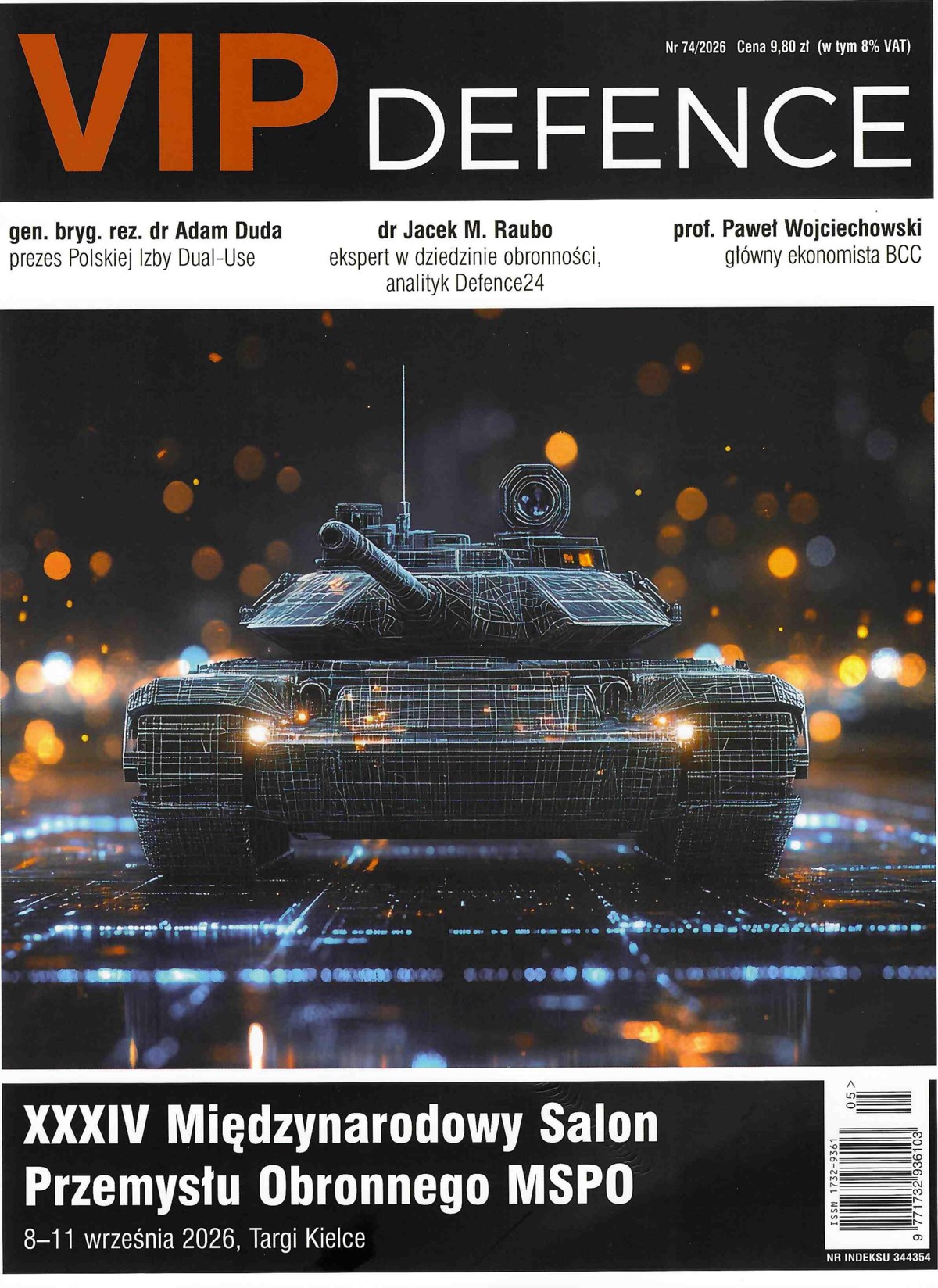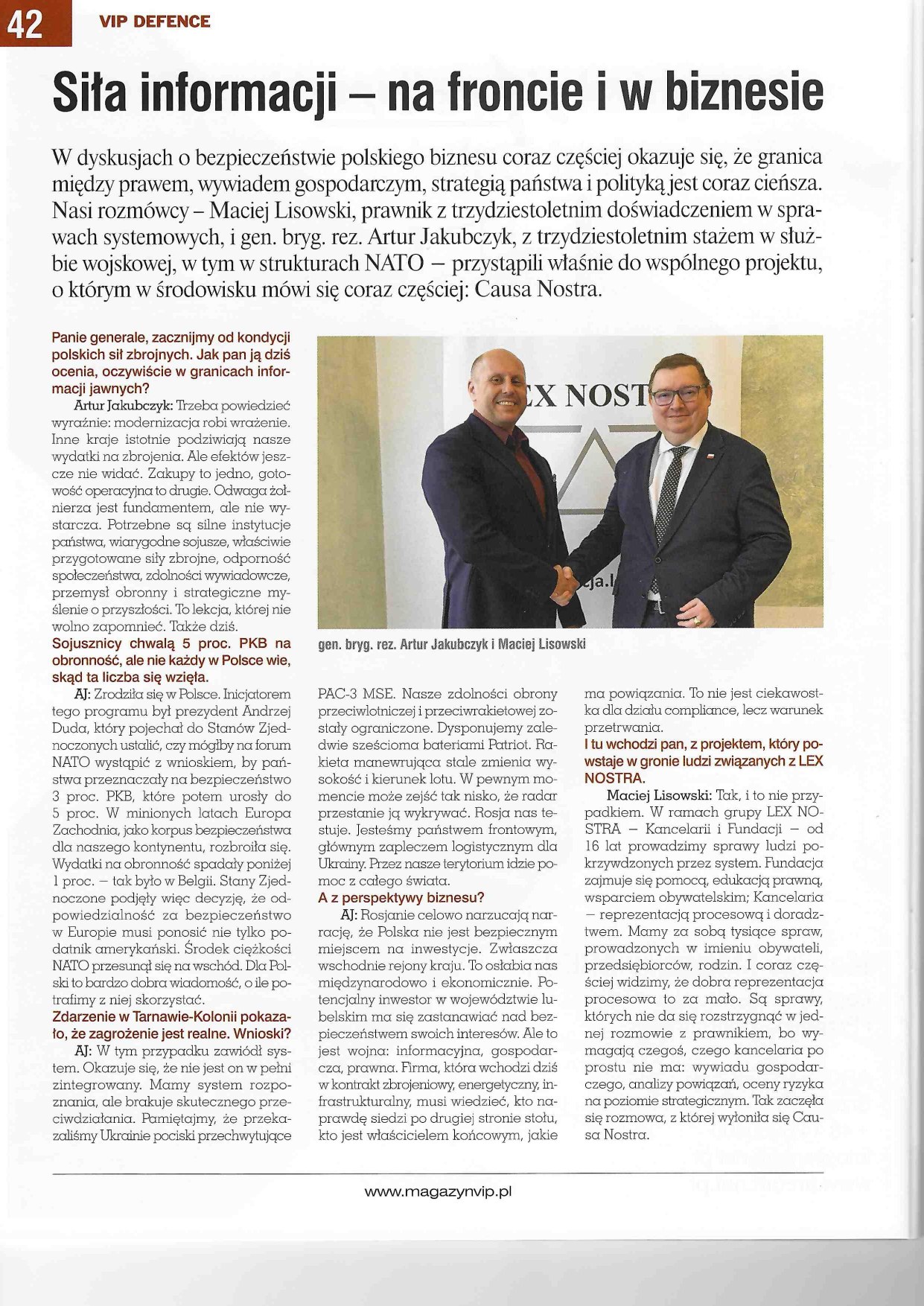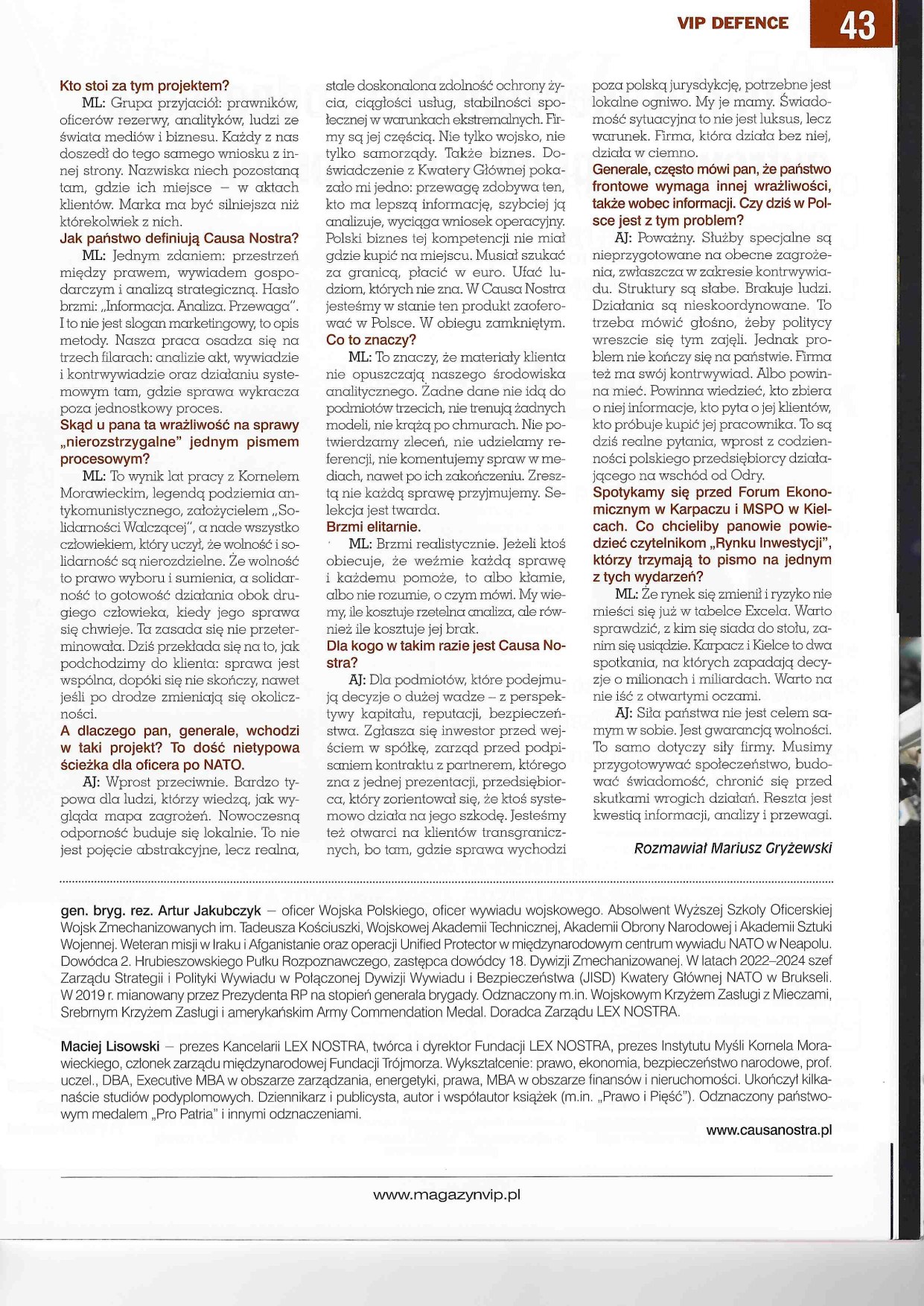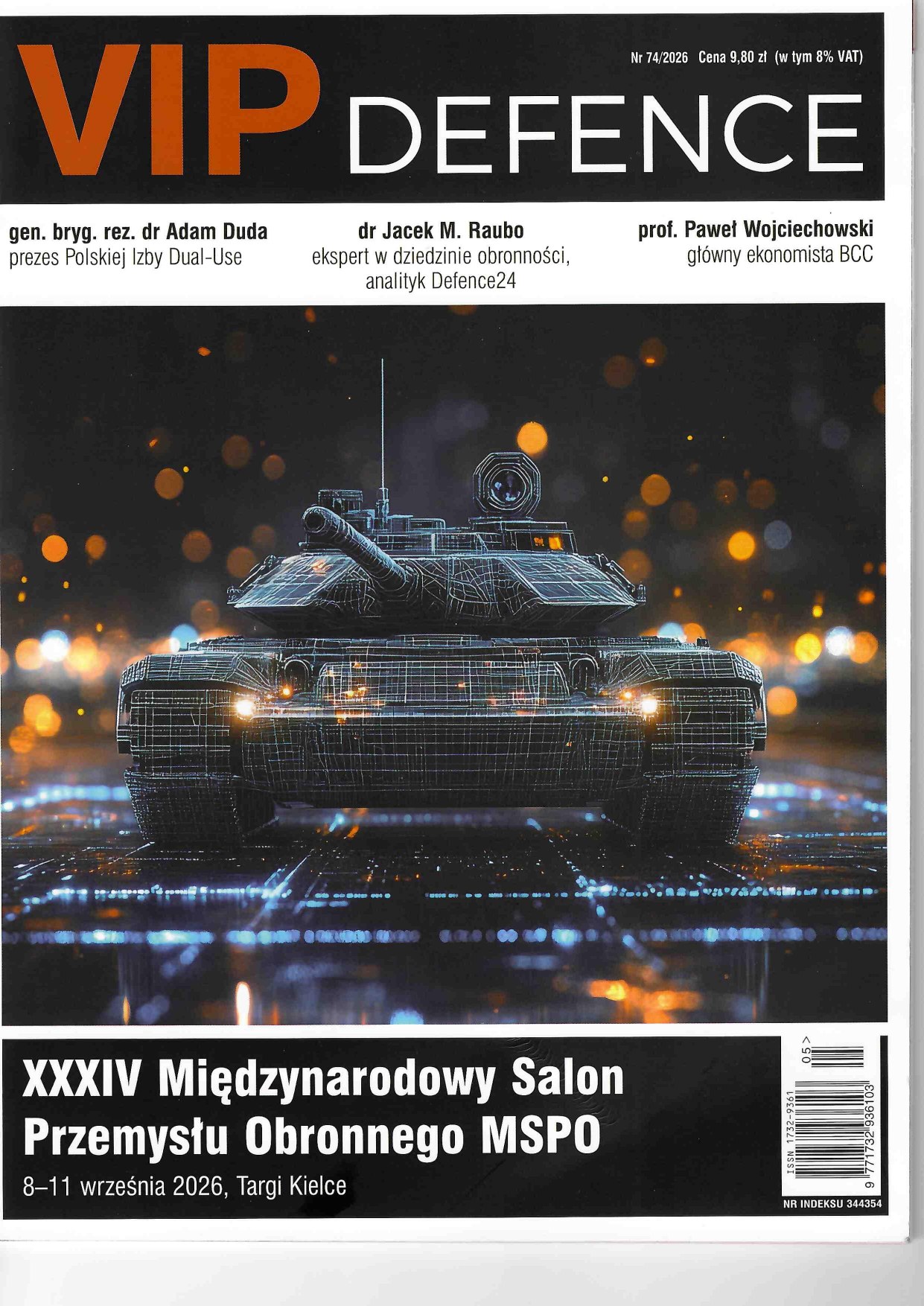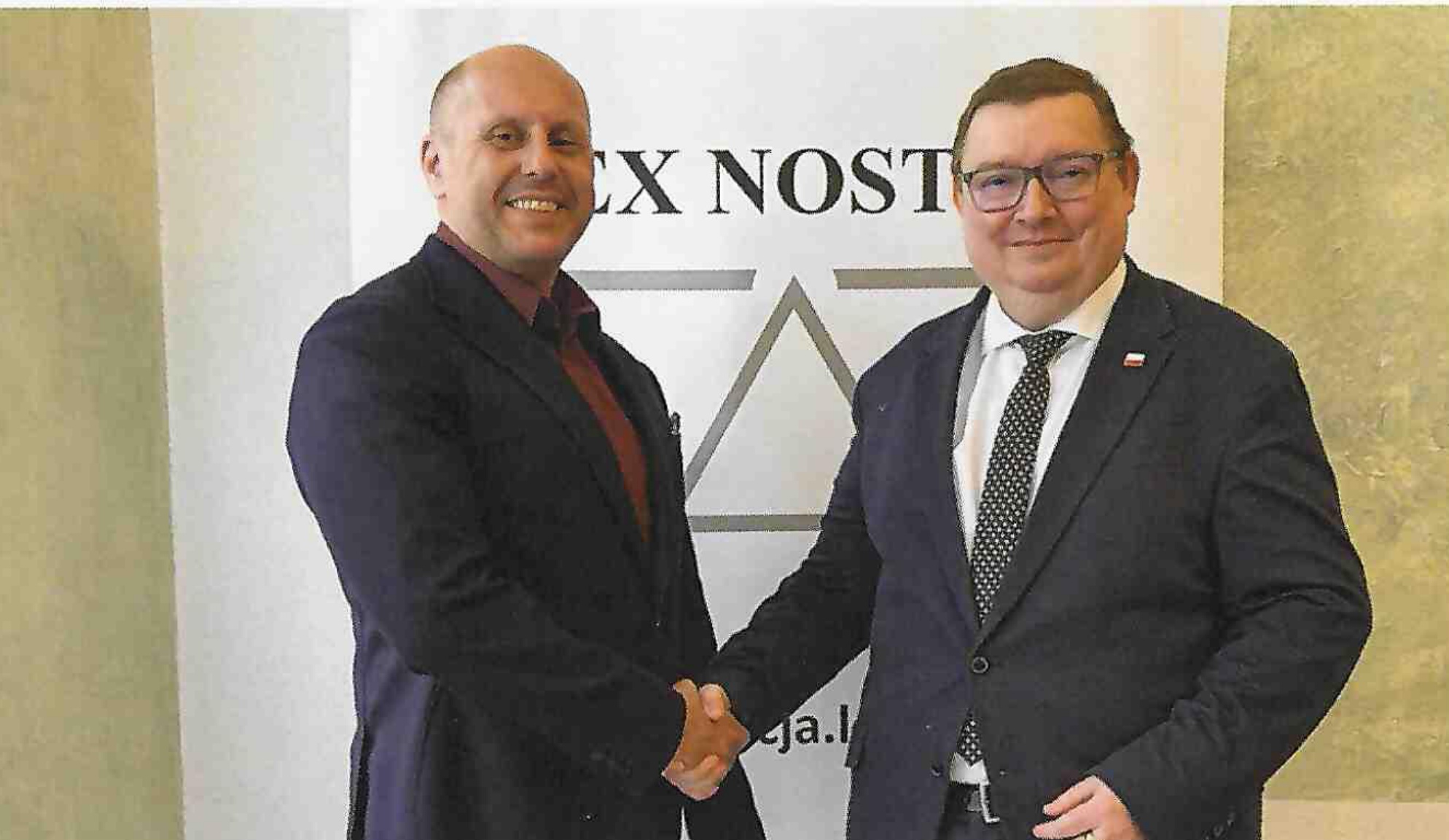
Ahead of the XXXV Economic Forum in Karpacz and the XXXIV International Defence Industry Exhibition (MSPO) in Kielce, “VIP DEFENCE” magazine published a joint interview with Maciej Lisowski and Brig. Gen. (res.) Artur Jakubczyk. The conversation covers the security conditions facing Polish business in a front-line state, the operational readiness of the armed forces, corporate counter-intelligence, and the CAUSA NOSTRA project — the space between law, business intelligence and strategic analysis.
Full interview
In debates about the security of Polish business, it is becoming increasingly clear that the line between law, business intelligence, state strategy and politics is thinner than ever. Our interviewees — Maciej Lisowski, a lawyer with thirty years of experience in systemic cases, and Brig. Gen. (res.) Artur Jakubczyk, with a thirty-year career in the armed forces, including in NATO structures — have just launched a joint project increasingly talked about in the community: Causa Nostra.
General, let us start with the condition of the Polish Armed Forces. How do you assess it today, obviously within the limits of open-source information?
Artur Jakubczyk: It has to be said plainly: the modernisation is impressive. Other countries genuinely admire our defence spending. But the effects are not yet visible. Purchases are one thing, operational readiness is another. A soldier’s courage is the foundation, but it is not enough. What is needed are strong state institutions, credible alliances, properly prepared armed forces, societal resilience, intelligence capabilities, a defence industry and strategic thinking about the future. That is a lesson we must not forget. Also today.
Our allies praise the 5 percent of GDP on defence, but not everyone in Poland knows where that figure came from.
AJ: It was born in Poland. The initiator of this programme was President Andrzej Duda, who travelled to the United States to establish whether he could put forward, in the NATO forum, a motion that states allocate 3 percent of GDP to security — which later grew to 5 percent. In the past years, Western Europe, as the security corps for our continent, disarmed itself. Defence spending fell below 1 percent — that was the case in Belgium. The United States therefore decided that responsibility for European security must be borne not only by the American taxpayer. NATO’s centre of gravity has shifted eastwards. For Poland this is very good news, provided we know how to make use of it.
The incident in Tarnawa-Kolonia showed that the threat is real. What are the conclusions?
AJ: In this case, the system failed. It turns out it is not fully integrated. We have a detection system, but we lack effective countermeasures. Let us remember that we transferred PAC-3 MSE interceptor missiles to Ukraine. Our air- and missile-defence capabilities have been reduced. We have only six Patriot batteries. A cruise missile constantly changes altitude and direction. At a certain point it can descend so low that the radar stops detecting it. Russia is testing us. We are a front-line state, the main logistical hub for Ukraine. Aid from all over the world passes through our territory.
And from a business perspective?
AJ: The Russians deliberately push the narrative that Poland is not a safe place to invest — especially the eastern regions of the country. That weakens us internationally and economically. A potential investor in Lubelskie Voivodeship is meant to have second thoughts about the safety of his interests. But this is a war: informational, economic, legal. A company entering today into an armaments, energy or infrastructure contract must know who really sits on the other side of the table, who the ultimate owner is, what connections they have. This is not a curiosity for the compliance department — it is a condition of survival.
And here you enter, with a project taking shape among people connected to LEX NOSTRA.
Maciej Lisowski: Yes, and not by accident. Within the LEX NOSTRA group — the Law Firm and the Foundation — for 16 years we have been handling cases of people harmed by the system. The Foundation deals with assistance, legal education, civic support; the Law Firm — with litigation representation and counselling. We have thousands of cases behind us, conducted on behalf of citizens, entrepreneurs and families. And we increasingly see that good litigation representation is not enough. There are matters that cannot be resolved in a single conversation with a lawyer, because they require something a law firm simply does not have: business intelligence, analysis of connections, risk assessment at the strategic level. That is how the conversation began from which Causa Nostra emerged.
Who stands behind this project?
ML: A group of friends: lawyers, reserve officers, analysts, people from the world of media and business. Each of us reached the same conclusion from a different direction. Let the names remain where they belong — in the clients’ files. The brand is meant to be stronger than any of them.
How do you define Causa Nostra?
ML: In one sentence: the space between law, business intelligence and strategic analysis. The motto is: “Information. Analysis. Advantage.” And this is not a marketing slogan — it is a description of the method. Our work rests on three pillars: case-file analysis, intelligence and counter-intelligence, and systemic action wherever a matter goes beyond an individual proceeding.
Where does this sensitivity to matters “unresolvable” by a single procedural pleading come from?
ML: It is the result of years of working with Kornel Morawiecki, a legend of the anti-communist underground, founder of “Fighting Solidarity”, and above all a man who taught that freedom and solidarity are inseparable. That freedom is the right of choice and of conscience, and solidarity is the readiness to act alongside another human being when his cause falters. That principle has not expired. Today it translates into how we approach the client: the case is shared, until it ends, even if circumstances change along the way.
And why do you, General, get involved in a project like this? It is a rather unusual path for an officer coming from NATO.
AJ: Quite the opposite. Very typical for people who know what the threat map looks like. Modern resilience is built locally. It is not an abstract concept but a real, constantly refined capability to protect life, service continuity and social stability under extreme conditions. Companies are part of it. Not only the military, not only local governments. Business as well. My experience at Headquarters showed me one thing: the advantage is gained by whoever has better information, analyses it faster, and draws the operational conclusion. Polish business had nowhere to buy this competence locally. It had to look abroad, pay in euro, trust people it did not know. In Causa Nostra we are able to offer this product in Poland. In a closed circuit.
What does that mean?
ML: It means that client materials do not leave our analytical environment. No data goes to third parties, does not train any models, does not circulate in the cloud. We do not confirm engagements, do not give references, do not comment on cases in the media — even after they are closed. Besides, we do not take every case. Selection is strict.
That sounds elitist.
ML: It sounds realistic. If somebody promises to take every case and help everyone, they are either lying or do not understand what they are talking about. We know how much a reliable analysis costs — but also how much the lack of one costs.
So for whom, then, is Causa Nostra?
AJ: For entities that make decisions of major weight — from the perspective of capital, reputation, security. An investor comes forward before entering into a company, a management board before signing a contract with a partner known from a single presentation, an entrepreneur who has realised that someone is systemically acting to his detriment. We are also open to cross-border clients, because where a case goes beyond Polish jurisdiction, a local link is needed. We are that link. Situational awareness is not a luxury but a condition. A firm operating without it operates blind.
General, you often say that a front-line state requires a different sensitivity, also towards information. Is there a problem with that today in Poland?
AJ: A serious one. The special services are unprepared for the current threats, especially in the area of counter-intelligence. The structures are weak. There is a shortage of people. Actions are uncoordinated. This has to be said out loud so that politicians finally deal with it. But the problem does not end at the state. A company also has its own counter-intelligence. Or it should. It should know who is gathering information about it, who is asking about its clients, who is trying to buy its employee. These are real questions today, straight from the everyday life of a Polish entrepreneur operating east of the Oder.
We meet ahead of the Economic Forum in Karpacz and MSPO in Kielce. What would you like to say to the readers holding this magazine at one of these events?
ML: That the market has changed and risk no longer fits into an Excel spreadsheet. It is worth checking with whom you are sitting down at the table before you sit down. Karpacz and Kielce are two gatherings at which decisions on millions and billions are taken. It is worth going there with eyes wide open.
AJ: The strength of the state is not a goal in itself. It is a guarantee of freedom. The same applies to the strength of a company. We must prepare society, build awareness, protect ourselves from the consequences of hostile action. The rest is a matter of information, analysis and advantage.
Interview conducted by Mariusz Gryżewski
Biographical notes
Brig. Gen. (res.) Artur Jakubczyk
Officer of the Polish Armed Forces, military intelligence officer. Graduate of the Tadeusz Kościuszko Higher Officer School of Mechanised Forces, the Military University of Technology, the National Defence Academy and the War Studies Academy. Veteran of missions in Iraq and Afghanistan and of Operation Unified Protector at the international NATO intelligence centre in Naples. Commander of the 2nd Hrubieszów Reconnaissance Regiment, deputy commander of the 18th Mechanised Division. In 2022–2024 Head of the Intelligence Strategy and Policy Division at the Joint Intelligence and Security Division (JISD) of NATO Headquarters in Brussels. In 2019 promoted by the President of the Republic of Poland to the rank of brigadier general. Decorated, among others, with the Military Cross of Merit with Swords, the Silver Cross of Merit and the U.S. Army Commendation Medal. Adviser to the Management Board of LEX NOSTRA.
Maciej Lisowski
President of the LEX NOSTRA Law Firm, founder and Director of the LEX NOSTRA Foundation, President of the Kornel Morawiecki Institute of Thought, member of the Management Board of the international Three Seas Foundation. Education: law, economics, national security, university professor, DBA, Executive MBA in the area of management, energy, law; MBA in the area of finance and real estate. Completed more than a dozen postgraduate programmes. Journalist and columnist, author and co-author of books (including “Prawo i Pięść”). Decorated with the state medal “Pro Patria” and other distinctions.